
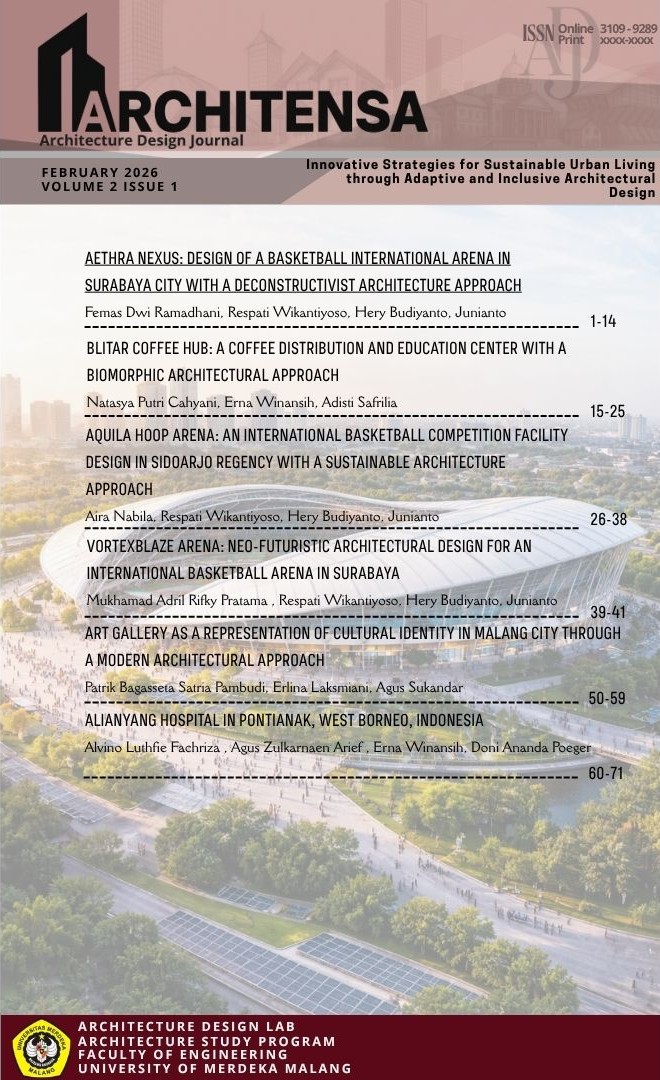
AQUILA HOOP ARENA: AN INTERNATIONAL BASKETBALL COMPETITION FACILITY DESIGN IN SIDOARJO REGENCY WITH A SUSTAINABLE ARCHITECTURE APPROACH
DOI:
https://doi.org/10.26905/adj.v2i1.16849Keywords:
: International Basketball, Sustainable Architecture, Metaphorical ArchitectureAbstract
The Design of Aquila Hoop Arena aims to provide international basketball competition facilities that are adaptive to the tropical climate in Sidoarjo Regency. Sidoarjo was chosen based on considerations of its strategic location near Juanda Airport and adequate infrastructural support. The main challenges in this design are high solar heat intensity and noise pollution from aviation activities. The design method employs a sustainable architectural approach by integrating local fauna. The design results not only implement these two approaches but also a metaphor of a basketball hoop on the building mass and the silhouette of the Garuda bird's wings as a symbol of national strength. Ecological strategies are implemented through a building envelope that adapts the morphology of Pangolin scales to optimize thermal comfort and energy efficiency in the building. Furthermore, the application of the urban forest concept serves as a noise buffer and heat reduction for the arena area. This design is expected to not only become a new sports icon but also a model for public buildings that are responsive to environmental context and locality.
Downloads
References
Agnes, R., Hutabarat, G., Warouw, F., Punuh, C. S., Cermin, K. P., Cermin, P., Pengajar, S., Universitas, A., Ratulangi, S., Pengajar, S., Universitas, A., & Ratulangi, S. (2019). No Title. 189–198.
Aletta, F., Oberman, T., & Kang, J. (2018). Associations between positive health-related effects and perceptual constructs of soundscapes: A systematic review. International Journal of Environmental Research and Public Health, 15(11), 2392. https://doi.org/10.3390/ijerph15112392/
Arlianto, A., Arch, M. A., Arsitektur, P. S., Petra, U. K., & Siwalankerto, J. (2019). Gambar. 1. Perspektif Bangunan ( . VII(2), 9–16.
Badarnah, L., & Knaack, U. (2018). Biologically-inspired double skin facades for hot climates: A parametric approach for performative design. Energy Procedia, 145, 142-147.
Chen Austin, M. A., Soto, M. G., Pinto, P. A., & Adames, A. (2022). Numerical assessment of zebra-stripes-based strategies in buildings energy performance: A case study under tropical climate. Biomimetics, 7(1), 14. https://doi.org/10.3390/biomimetics7010014
Revista Fecheyr-Lippens, D., & Bhiwapurkar, P. (2017). Applying biomimicry to design building envelopes that lower energy consumption in a hot-humid climate. Architectural Science Review, 60(6), 478-489. https://doi.org/10.1080/00038628.2017.1359145
Hays, N., Badarnah, L., & Jain, A. (2024). Biomimetic design of building facades: An evolutionary-based computational approach inspired by elephant skin for cooling in hot and humid climates. Frontiers in Built Environment, 10, 1309621. https://doi.org/10.3389/fbuil.2024.1309621
Hidayatulloh, S. (2021). Kajian Prinsip Arsitektur Berkelanjutan Pada Bangunan Perkantoran ( Studi Kasus : Menara Bca Jakarta ). 18(1), 89–97.
Hong, X., Liu, J., & Wang, G. (2022). Soundscape in urban forests. Forests, 13(12), 2056. https://doi.org/10.3390/f13122056
Korol, E., Shushunova, N., & Passmore, D. (2018). Technical and economical factors in green roof using to reduce the aircraft noise. MATEC Web of Conferences, 170, 01081. https://doi.org/10.1051/matecconf/201817001081
Lugten, M., Karacaoglu, M., Kang, J., & Steemers, K. (2018). Improving the soundscape quality of urban areas exposed to aircraft noise by adding moving water and vegetation. The Journal of the Acoustical Society of America, 144(4), 2906-2917. https://doi.org/10.1121/1.5079310
Mutlu Avinç, G., Koç, S. N., & Arslan Selçuk, S. (2024). Biomimetic facade design proposal to improving thermal comfort in hot climate region. International Journal of Built Environment and Sustainability, 11(2), 117-128. https://doi.org/10.11113/ijbes.v11.n2.1226
Salah, T., Mohamed, O., & Azmy, A. (2018). The elements of natural concept in sustainable building skins. ISEC Research Proceedings, 56. https://doi.org/10.14455/ISEC.RES.2018.56
Skärbäck, E. (2007). Urban forests as compensation measures for infrastructure development. Urban Forestry & Urban Greening, 6(4), 279-285. https://doi.org/10.1016/j.ufug.2007.05.006
Twardowski, M. (2018). Football stadiums – Icons of sports architecture. Czasopismo Techniczne, 10, 153-166. https://doi.org/10.4467/2353737XCT.18.162.9418
Widyawati, R. L. (n.d.). Green Building Dalam Pembangunan Berkelanjutan. Widyawati, R. (n.d.). Prinsip arsitektur berkelanjutan dalam pembangunan masa depan. Jurnal Arsitektur Indonesia.
Yildirim, Y., Arefi, M., & Şensöz, E. (2022). Soundscape assessment of green and blue infrastructures. Urban Science, 6(1), 22. https://doi.org/10.3390/urbansci6010022
Downloads
Published
How to Cite
Issue
Section
License
Copyright (c) 2026 Aira Nabila, Respati Wikantiyoso, Hery Budiyanto, Junianto

This work is licensed under a Creative Commons Attribution-ShareAlike 4.0 International License.
Authors who publish in this journal agree to the following terms:
(1) Copyright of the published articles will be transferred to the journal as the publisher of the manuscripts. Therefore, the author confirms that the journal has managed the copyright.
(2) The publisher of DEPOSITORY: Architectural Design Journal is the Architecture Study Program, Faculty of Engineering, the University of Merdeka Malang.
(3) The copyright follows Creative Commons Attribution–ShareAlike License (CC BY SA): This license allows to Share ” copy and redistribute the material in any medium or format, Adapt” remix, transform, and build upon the material, for any purpose, even commercially.