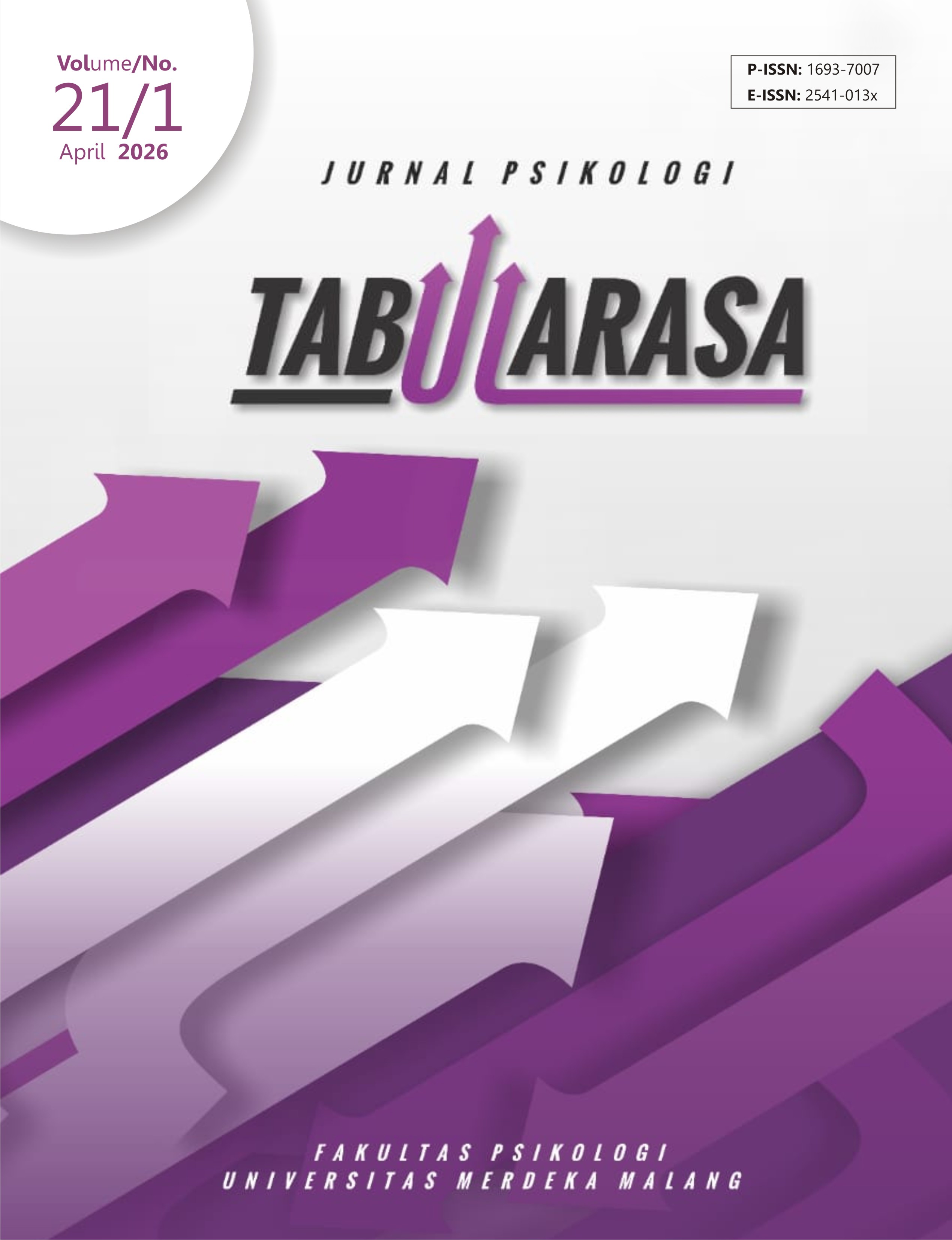
The effect of family support on work-life balance mediated by job stress among Universitas Terbuka students
DOI:
https://doi.org/10.26905/jpt.v21i1.17232Keywords:
Family support, Work life balance, Job stress, StudentsAbstract
The phenomenon of working students is increasingly common. Students often struggle to balance their time between completing work assignments and academic tasks, as they must simultaneously manage their studies, careers, and family responsibilities. Consequently, achieving a healthy work-life balance is essential for students to actively fulfill their roles in both professional and personal spheres. This balance often relies on family support as a primary external factor, while job stress also significantly affects an individual's work-life balance. This study aims to examine the effect of family support on work-life balance, mediated by job stress. Using an explanatory quantitative design, the study sampled 260 students at Universitas Terbuka Medan. Data were analyzed using Structural Equation Modeling (SEM) executed through the SmartPLS software. The results indicate that job stress mediates the effect of family support on students' work-life balance. These findings contribute to addressing low work-life balance among students, highlighting how it is influenced by family support through the mediating role of job stress.
Downloads
References
Agustina, D. D. (2018). Uji validitas ukur stres. JP3I (Jurnal Pengukuran Psikologi dan Pendidikan Indonesia), 7(2), 86–91. https://doi.org/10.15408/jp3i.v7i2.12100
Bahar, D. F., & Prasetio, A. P. (2021). Pengaruh stres kerja terhadap work-life balance pada karyawan perum bulog Jakarta Selatan. E-Proceeding of Management, 8(4), 3276-3281.
Bakker, A. B., & Demerouti, E. (2007). The job demands‐resources model: State of the art. Journal of Managerial Psychology, 22(3), 309-328. https://doi.org/10.1108/02683940710733115
Boas, A. A. V. (2018). Mental health, work-related stress and work-life balance in public universities: A comparison between Brazilian and Canadian professors. Journal of Education, Society and Behavioural Science, 25(3), 1-13. https://doi.org/10.9734/JESBS/2018/41820
Cahyadi, L., & Prastyani, D. (2020). Mengukur work life balance, stres kerja dan konflik peran terhadap kepuasan kerja pada wanita pekerja. Jurnal Ekonomi: Journal of Economic, 11(02), 172–177.
Fatimah, P., Effendy, S., & Lubis, R. (2022). Peran dukungan keluarga dan stres kerja terhadap work – life balance pada paramedis keperawatan wanita di rumah sakit Kota Medan. Journal of Education, Humaniora and Social Sciences (JEHSS), 5(2), 1347–1355. https://doi.org/10.34007/jehss.v5i2.1480
Firmansyah, Y. (2016). Komperatif faktor work life balance (studi pada mahasiswa bekerja dan tidak bekerja di Kota Bandung). Manajemen dan Bisnis (Performa), 13(2), 99–117. https://doi.org/10.29313/performa.v0i2.2631
French, K. A., Dumani, S., Allen, T. D., & Shockley, K. M. (2018). A meta-analysis of work–family conflict and social support. Psychological Bulletin, 144(3), 284-314. https://doi.org/10.1037/bul0000120
Greenhaus, J. H., Collins, K. M., & Shaw, J. D. (2003). The relation between work–family balance and quality of life. Journal of Vocational Behavior, 63(3), 510-531. https://doi.org/10.1016/S0001-8791(02)00042-8
Greenhaus, J. H., & Powell, G. N. (2006). When work and family are allies: A theory of work-family enrichment. The Academy of Management Review, 31(1), 72–92. https://doi.org/10.2307/20159186
Gunawan, G., Nugraha, Y., Sulastiana, M., & Harding, D. (2019). Reliabilitas dan validitas konstruk work life balance di Indonesia. Jurnal Penelitian dan Pengukuran Psikologi: JPPP, 8(2), 88-94. https://doi.org/10.21009/JPPP.082.05
Hair Jr., J. F., Hult, G. T. M., Ringle, C. M., Sarstedt, M., Danks, N. P., & Ray, S. (2021). Partial least squares structural equation modeling (PLS-SEM) using R. Springer Nature. https://doi.org/10.1007/978-3-030-80519-7
Hakim, A. R., & Hasmira, M. H. (2022). Strategi kuliah sambil bekerja oleh mahasiswa (Studi kasus: mahasiswa bekerja di Universitas Negeri Padang). Naradidik: Journal of Education and Pedagogy, 1(1), 30-37. https://doi.org/10.24036/nara.v1i1.6
Harb, A., & Keyrouz, N. (2022). A strategic assessment and evaluation of the major determinants of work-life balance for university student workers in Lebanon. Macro Management & Public Policies, 4(3), 29-38. https://doi.org/10.30564/mmpp.v4i3.5043
Haryono, S. (2016). Metode SEM untuk penelitian manajemen dengan AMOS 22.00, LISREL 8.80 dan Smart PLS 3.0. Luxima Metro Media.
Lambert, E. G., Minor, K. I., Wells, J. B., & Hogan, N. L. (2016). Social support's relationship to correctional staff job stress, job involvement, job satisfaction, and organizational commitment. The Social Science Journal, 53(1), 22-32. https://doi.org/10.1016/j.soscij.2015.10.001
Lapierre, L. M., Li, Y., Kwan, H. K., Greenhaus, J. H., DiRenzo, M. S., & Shao, P. (2018). A meta‐analysis of the antecedents of work–family enrichment. Journal of Organizational Behavior, 39(4), 385-401. https://doi.org/10.1002/job.2234
Mantri, S. P., & Kale, V. C. (2018). Influence of work life balance on occupational stress: A distinctive allusion to woman employees in it industry from Pune City. International Journal of Commerce, Economics, and Management, 3(1), 135–142.
Megayani, M., Santoso, J. B., & Sholikha, H. (2023). Pengaruh stres kerja dan motivasi kerja terhadap work life balance. Innovative: Journal of Social Science Research, 3(6), 3337-3352.
Peraturan Perundang-undangan. (2003). Undang-undang (UU) Nomor 13 Tahun 2003 tentang Ketenagakerjaan.
Planty, M., Hussar, W., Snyder, T., Kena, G., Kewalramani, A., Kemp, J., Bianco, K., & Dinkes, R. (2009). The condition of education 2009 (NCES 2009-081). National Center for Education Statistics, Institute of Education Sciences.
Poulose, S., & Sudarsan, N. (2017). Assessing the influence of work-life balance dimensions among nurses in the healthcare sector. Journal of Management Development, 36(3), 427-437. https://doi.org/10.1108/JMD-12-2015-0188
Ramdhania, T., & Yuniasanti, R. (2023). Hubungan antara support family dengan work life balance pada ibu yang bekerja di PT X. Wahana: Tridarma Perguruan Tinggi, 75(2), 130-137. https://doi.org/10.36456/wahana.v75i2.8287
Rivai, A. (2019). Pengaruh stres kerja dan lingkungan kerja terhadap keinginan perawat untuk berhenti bekerja pada Rumah Sakit Columbia Asia Medan. Abdi Ilmu, 12(2), 64-74.
Rizky, D., & Afrianty, T. W. (2018). Pengaruh beban kerja terhadap stress dengan work life balance sebagai variabel intervening (Studi pada Dinas Sosial Provinsi Jawa Timur Surabaya). Jurnal Administrasi Bisnis (JAB), 61(4), 47–53.
Safitri, A. E., & Gilang, A. (2020). Pengaruh stres kerja terhadap produktivitas kerja karyawan pada PT. Telkom Witel Bekasi. Jurnal Manajemen, Ekonomi dan Akuntansi, 4(1), 216-226. https://doi.org/10.31294/jeco.v3i2.5918
Sarafino, E. P & Smith, T. W. (2011). Health psychology : Biopsychosocial interaction. John Wiley & Sons.
Sirgy, M. J., & Lee, D. J. (2018). Work-life balance: An integrative review. Applied Research in Quality of Life, 13(1), 229-254. https://doi.org/10.1007/s11482-017-9509-8
Song, K. W., & Kim, H. K. (2019). Job stress and its related factors among Korean dentists: An online survey study. International Dental Journal, 69(6), 436-444. https://doi.org/10.1111/idj.12513
Subandy, K., & Jatmika, D. (2020). Hubungan psychological capital dengan coping stress pada mahasiswa yang bekerja. Psibernetika, 13(2), 68–82. https://doi.org/10.30813/psibernetika.v13i2.2382
Sugiyono. (2017). Metode penelitian kuantitatif, kualitatif dan R & D. Alfabeta.
Tetteh, E. N., & Attiogbe, E. J. K. (2019). Work–life balance among working university students in Ghana. Higher Education, Skills and Work-Based Learning, 9(4), 525-537. https://doi.org/10.1108/HESWBL-08-2018-0079
Wijianti, N. (2024). Work life balance pada mahasiswa yang bekerja di Kota Malang (Doctoral dissertation, Universitas Muhammadiyah Malang).
Downloads
Published
How to Cite
Issue
Section
License

This work is licensed under a Creative Commons Attribution-ShareAlike 4.0 International License.