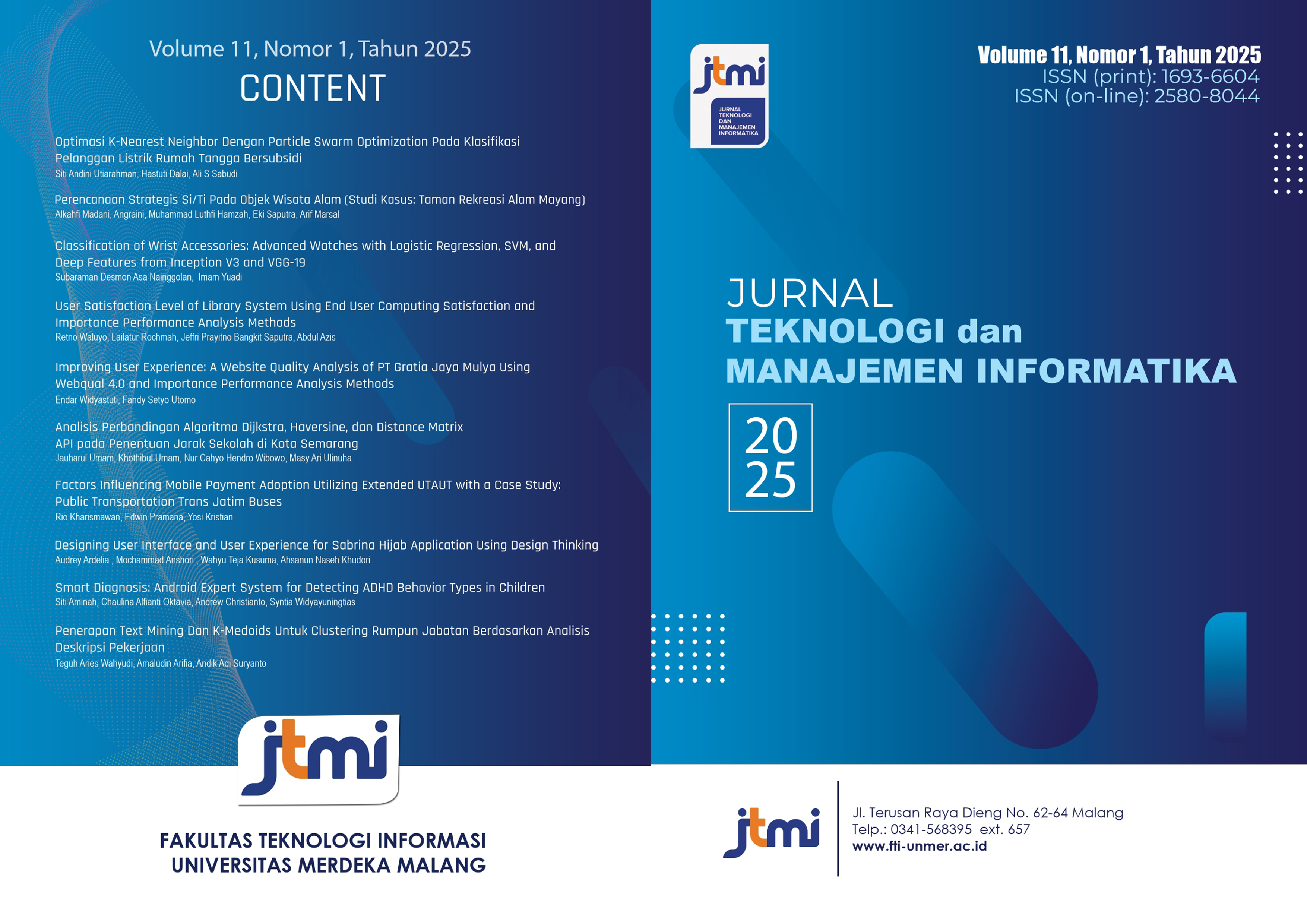
Factors Influencing Mobile Payment Adoption Utilizing Extended UTAUT with a Case Study: Public Transportation Trans Jatim Buses
DOI:
https://doi.org/10.26905/jtmi.v11i1.15649Keywords:
Mobile Payment, UTAUT, Public Transportation, SEM, AMOSAbstract
Mobile payment is widely used across sectors, but its adoption in Bus Trans Jatim remains low, with only 18% of passengers using it monthly in 2024. This study explores factors influencing users’ behavioral intention to adopt mobile payment by extending the UTAUT model, incorporating performance expectancy, effort expectancy, social influence, trust, and external factors like network externalities and promotional activities, with education and location as moderating variables. Using a quantitative approach and 432 valid responses collected via online questionnaires, data were analyzed through SEM with AMOS 22. The results show that five out of six variables significantly affect behavioral intention, except for promotional activities. Furthermore, education and location did not significantly moderate the relationships. This research contributes to technology adoption theory and offers practical guidance for transport providers to prioritize performance, ease of use, social influence, and trust in promoting mobile payment usage.
Downloads
References
Y. Zhao & F. Bacao. (2021). How does the pandemic facilitate mobile payment? An investigation on users’ perspective under the COVID-19 pandemic. Int J Environ Res Public Health, vol. 18, no. 3, pp. 1–22, doi: 10.3390/ijerph18031016.
Q. M. Ajao, O. Oludamilare, & L. Sadeeq. (2023). Drivers of Mobile Payment Acceptance: The Impact of Network Externalities in Nigeria. OAlib, vol. 10, no. 06, pp. 1–19, 2023, doi: 10.4236/oalib.1110240.
K. Al-Saedi, M. Al-Emran, T. Ramayah, & E. Abusham. (2020). Developing a general extended UTAUT model for M-payment adoption. Technol Soc, vol. 62, doi: 10.1016/j.techsoc.2020.101293.
A. A. Linge, T. Chaudhari, B. B. Kakde, & M. Singh. (2023). Analysis of Factors Affecting Use Behavior towards Mobile Payment Apps: A SEM Approach. Hum Behav Emerg Technol, vol. 2023, doi: 10.1155/2023/3327994.
F. Alduais & M. O. Al-Smadi. (2022). Intention to Use E-Payments from the Perspective of the Unified Theory of Acceptance and Use of Technology (UTAUT): Evidence from Yemen. Economies, vol. 10, no. 10, doi: 10.3390/economies10100259.
R. O. Alademomi et al.. (2019). Usage of E-Payment on Bus Rapid Transit (BRT): An Empirical Test, Public Acceptance and Policy Implications in Lagos, Nigeria. International Journal of Business and Social Science, vol. 10, no. 2, doi: 10.30845/ijbss.v10n2p14.
E. Pramana. (2021). The Mobile Payment Adoption: A Systematic Literature Review. 3rd East Indonesia Conference on Computer and Information Technology (EIConCIT), pp. 265–269. doi: 10.1109/EIConCIT50028.2021.9431846.
N. H. Do, J. Tham, S. M. Ferdous Azam, & A. A. Khatibi. (2020). The effects of factors influencing on user behavior intention to use mobile payment: Evidence from cambodia. International Journal of Data and Network Science, vol. 4, no. 2, pp. 213–224, doi: 10.5267/j.ijdns.2019.12.004.
J. Fan, M. Shao, Y. Li, & X. Huang. (2018). Understanding users’ attitude toward mobile payment use: A comparative study between China and the USA. Industrial Management and Data Systems, vol. 118, no. 3, pp. 524–540, doi: 10.1108/IMDS-06-2017-0268.
G. Wang, N. M. Putri, A. Christianto, & W. Hutama. (2019). An empirical examination of characteristics of mobile payment users in Indonesia. J Theor Appl Inf Technol, vol. 97, pp. 169–182.
V. Venkatesh, M. Morris, G. Davis, & F. Davis. (2003). User Acceptance of Information Technology: Toward a Unified View. MIS Quarterly, vol. 27, pp. 425–478, doi: 10.2307/30036540.
Prasetyo. (2017). Penerapan Metode UTAUT (Unified Theory of Acceptance and Use of Technology) Dalam Memahami Penerimaan dan Penggunaan Website KKN LPPM UNISI.
F. Liébana-Cabanillas, A. Japutra, S. Molinillo, N. Singh, & N. Sinha. (2020). Assessment of mobile technology use in the emerging market: Analyzing intention to use m-payment services in India. Telecomm Policy, vol. 44, no. 9, p. 102009, doi: https://doi.org/10.1016/j.telpol.2020.102009.
L. Lisana. (2020). Factors influencing the adoption of mobile payment systems in Indonesia. International Journal of Web Information Systems, vol. 17, no. 3, doi: 10.1108/IJWIS-01-2021-0004.
L. Lisana. (2024). Understanding the key drivers in using mobile payment among Generation Z. Journal of Science and Technology Policy Management, vol. 15, no. 1, pp. 122–141, doi: 10.1108/JSTPM-08-2021-0118.
F. L. Abegao Neto & J. C. B. de Figueiredo. (2023). Effects of age and income moderation on adoption of mobile payments in Brazil. Innovation and Management Review, vol. 20, no. 4, pp. 353–364, doi: 10.1108/INMR-06-2021-0109.
N. Tomić, Z. Kalinić, & V. Todorović. (2023). Using the UTAUT model to analyze user intention to accept electronic payment systems in Serbia. Portuguese Economic Journal, vol. 22, no. 2, pp. 251–270, doi: 10.1007/s10258-022-00210-5.
M. Noor Ardiansah, N. Nur Azmi, & I. Anisykulillah. (2024). Understanding Determinants of Use Behavior of E-Payment: An Analysis of the Success of the System During a Pandemic.
T. Dahlberg, J. Guo, & J. Ondrus. (2015). A critical review of mobile payment research. Electron Commer Res Appl, vol. 14, pp. 265–284, doi: 10.1016/j.elerap.2015.07.006".
M. Karsen, Y. Chandra, & H. Juwitasary. (2019). Technological Factors of Mobile Payment: A Systematic Literature Review. Procedia Comput Sci, vol. 157, pp. 489–498, doi: 10.1016/j.procs.2019.09.004.
Park, J. (2019). Validity Issues in Qualitative and Quantitative Research of Cross-National Studies. In L. E. Suter, E. Smith, & B. D. Denman (Eds.), The SAGE Handbook of Comparative Studies in Education (pp. 162-175). Thousand Oaks, CA: Sage Publications, pp. 162–175.
G. D. Israel. (1992). Determining Sample Size 1 The Level Of Precision.
A. Qasim & E. Abu-Shanab. (2015). Drivers of mobile payment acceptance: The impact of network externalities. Information Systems Frontiers, vol. 18, pp. 1021–1034, doi: 10.1007/s10796-015-9598-6.
R. Abrahão, S. Moriguchi, & D. Andrade. (2016). Intention of adoption of mobile payment: An analysis in the light of the Unified Theory of Acceptance and Use of Technology (UTAUT). RAI Revista de Administração e Inovação, vol. 13, doi: 10.1016/j.rai.2016.06.003.
D. Straub & D. Gefen. (2014). Validation Guidelines for IS Positivist Research. Communications of the Association for Information Systems, vol. 13, doi: 10.17705/1cais.01324.
M. A. Sabri Alrawi et al.. (2020). Examining factors that effect on the acceptance of mobile commerce in Malaysia based on revised UTAUT. Indonesian Journal of Electrical Engineering and Computer Science, vol. 20, no. 3, pp. 1173–1184, doi: 10.11591/ijeecs.v20.i3.pp1173-1184.
Chen, L. (2008). A Model of ConsumerAcceptance of Mobile Payment. IJMC, 6, 32–52. https://doi.org/10.1504/IJMC.2008.015997
U. Prajogo, M. Zulfiqar, N. Maulana, A. History, & S. Malangkucecwara. (2023). Jurnal Teknologi dan Manajemen Informatika Moderasi Promosi pada Pengaruh Perceived Ease of Use terhadap Minat Penggunaan Paylater Artivcle Info ABSTRACT. vol. 9, no. 2, pp. 141–150. [Online]. Available: http://http://jurnal.unmer.ac.id/index.php/jtmi
J. Prayitno, B. Saputra, R. Waluyo, D. P. Lestari, & S. A. Ramadhani. (2024). Jurnal Teknologi dan Manajemen Informatika Penerimaan Teknologi QRIS bagi Pelaku UMKM Kabupaten Banyumas Menggunakan Technology Acceptance Model (TAM). vol. 10, no. 2, pp. 133–142, 2024, [Online]. Available: http://http://jurnal.unmer.ac.id/index.php/jtmi
U. Prajogo STIE Malangkucecwara, R. Artikel, & K. Kunci. (2021). Jurnal Teknologi dan Manajemen Informatika Pengaruh Perceived Ease Of Use dan Perceived Usefulness terhadap Penggunaan Teknologi Marketplace dengan Attitude sebagai Variabel Intervening (Studi Pada UMKM di Kota Malang). vol. 7, pp. 62–68, [Online]. Available: http://http://jurnal.unmer.ac.id/index.php/jtmi
Downloads
Published
How to Cite
Issue
Section
License

This work is licensed under a Creative Commons Attribution-ShareAlike 4.0 International License.
Authors who publish with this journal agree to the following terms:
(1) Copyright of the published articles will be transferred to the journal as the publisher of the manuscripts. Therefore, the author confirms that the copyright has been managed by the journal.
(2) Publisher of JTMI: Jurnal Teknologi dan Manajemen Informatika is University of Merdeka Malang.
(3) The copyright follows Creative Commons Attribution ShareAlike License (CC BY SA): This license allows to Share copy and redistribute the material in any medium or format, Adapt remix, transform, and build upon the material, for any purpose, even commercially.